Beauty, flood protection, cooler homes and better health — the evidence behind the small patch of ground at your door
Your front garden is the first thing anyone sees of your home, and the last thing you see when you leave it each morning. Yet across the UK it is quietly disappearing. The Royal Horticultural Society’s Greening Grey Britain report found that around one in four front gardens had been completely paved over, three times as many as a decade earlier, and nearly one in three contained no plants at all. London was the worst affected: half of all front gardens had been paved or concreted, a 36% rise in ten years.
Paving can feel like the practical, low-maintenance choice. But a growing body of scientific research shows that a planted front garden is far more than decoration. It shapes how your home looks and feels, protects your street from flooding, replenishes the water we drink, keeps your house cooler in a heatwave, and measurably lowers stress. Here is why — and what the science says.
1. The first impression: beauty and character
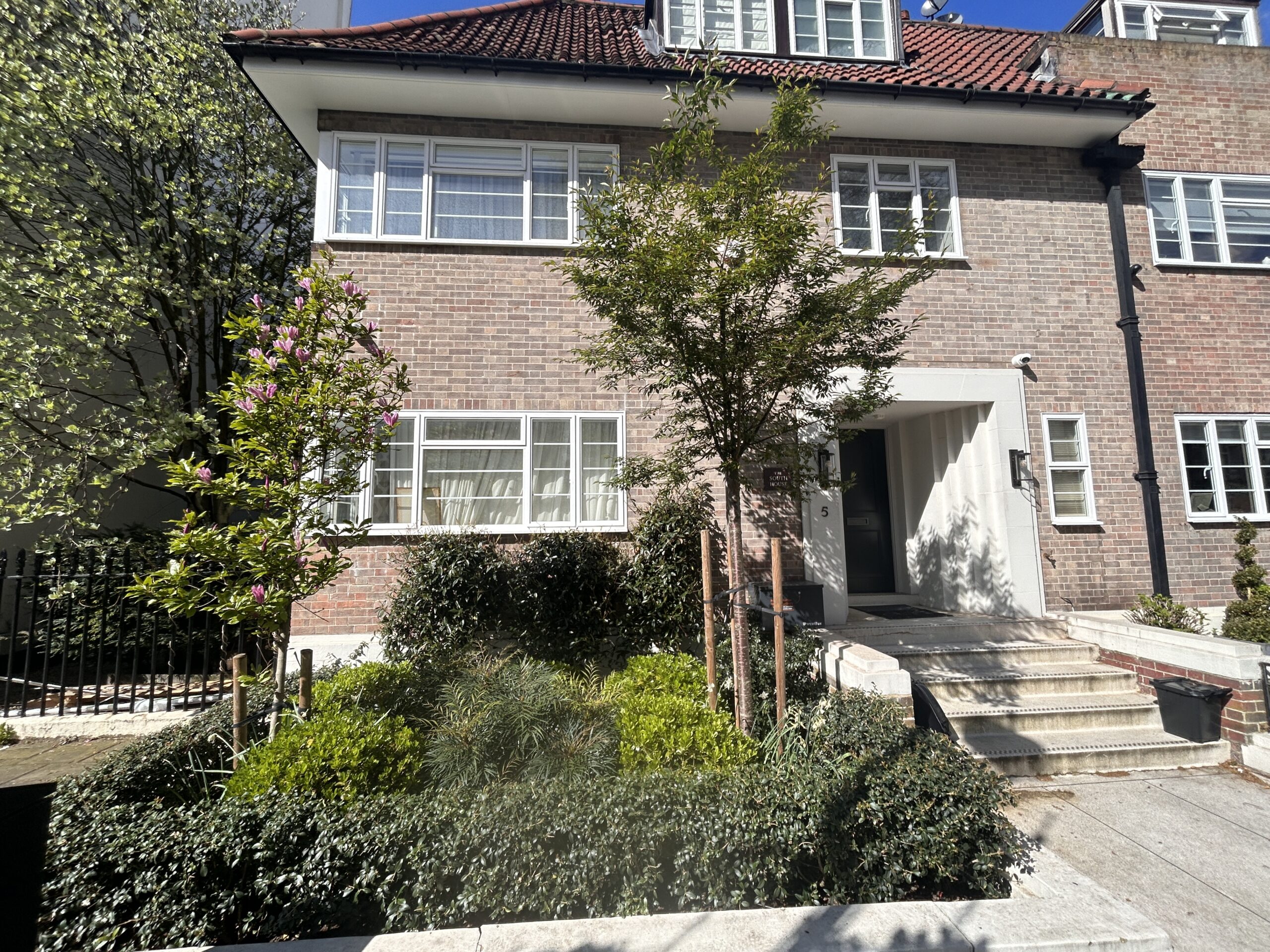
A front garden frames the architecture of a house. Planting softens hard lines, gives depth and layers to a façade, and changes with the seasons, so the home never looks quite the same twice — spring bulbs, summer colour, autumn foliage, the structure of evergreens and bare branches in winter. A sea of block paving, by contrast, reads the same all year and tends to make a house look smaller, harder and more anonymous.
The effect goes beyond the individual home. Front gardens form the shared face of a street. Research for a University of Sheffield PhD on front gardens found that people see them as part of their identity and self-expression, and as a way of contributing positively to their neighbourhood. In an RHS-led experiment (described in section 5), residents whose bare front gardens were planted went on to garden more and to improve other parts of their homes — a single planted plot can set off a chain of care along a whole street.
I saw this for myself when I moved to London ten years ago. Looking after my own front garden became a natural conversation starter, and it was through it that I first got to know my neighbours. A few plants by the door can do more for a street than you might expect.
Good design does not mean giving up practicality. Parking, bins, bikes and a welcoming path can all sit comfortably alongside generous planting when the space is planned as a whole.
2. A garden that drinks the rain: protecting against flooding
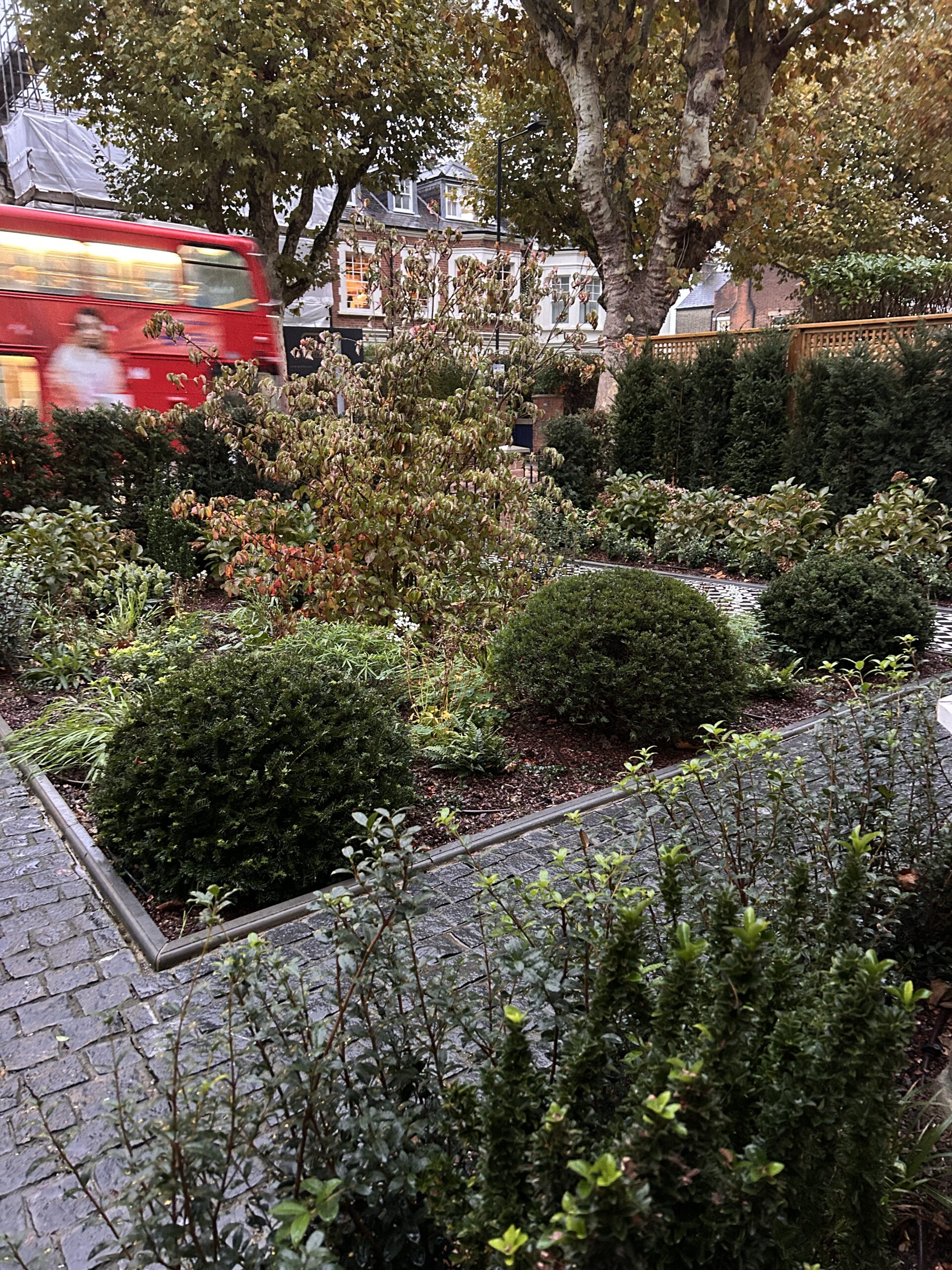
When rain falls on soil and plants, much of it soaks in. When it falls on tarmac, concrete or sealed paving, almost all of it runs straight off into street drains. One paved garden makes little difference; thousands of them, street after street, add up to a serious problem — drains are overwhelmed in heavy downpours and water ends up in roads, gardens and homes.
This is not a hypothetical risk. The Environment Agency’s 2024 National Flood Risk Assessment found that around 4.6 million properties in England are in areas at risk of surface water (flash) flooding — the kind caused when rainfall overwhelms drainage. About 1.1 million of these are at high risk, including roughly 320,000 in London alone, and with climate change the number at high risk could rise to around 1.8 million by mid-century.
This is why, since October 2008, planning rules in England have treated front-garden paving as a drainage issue: laying more than five square metres of impermeable surface in a front garden generally requires planning permission unless the water is directed to a permeable area. Every planted bed, lawn, gravel area or permeable driveway acts as a small sponge that slows the water down and lets it soak back into the ground.
3. Back to the water table: why groundwater matters to all of us
Where does that rainwater go once it soaks in? Some is taken up by plants and soil, but some percolates slowly downwards into aquifers — layers of porous rock such as chalk and sandstone that hold water in their tiny pores and cracks, like a vast underground sponge. The upper surface of that saturated zone is the water table.
The water table is far more important to daily life than most people realise:
- It is our drinking water. According to the British Geological Survey, groundwater provides around a third of public water supply in England. In south-east England the figure rises to over 75%, with most of it drawn from the Chalk aquifer. If you live in the South East, there is a good chance the water in your tap fell as rain on the ground around you.
- It keeps rivers alive in summer. Aquifers feed springs, streams and rivers, sustaining them through dry spells. England’s rare chalk streams depend on it almost entirely — in the Chilterns, more than 90% of the River Misbourne’s flow comes from groundwater. When groundwater falls too low, these rivers simply dry up: at the height of the 2019 drought, almost two-thirds of the Chilterns’ chalk-stream habitat was dry.
- It is our buffer against drought. Aquifers are refilled mainly between October and March, when plants use little water and rain can soak deep into the ground. Because that store builds up over months, groundwater is far more resilient than reservoirs. During the drought of summer 2026, British Geological Survey scientists noted that groundwater levels remained in remarkably good health even as reservoir stocks fell well below normal.
Every hard surface that sends rain into a drain instead of into the soil is water lost to this natural reservoir. A single front garden will not refill an aquifer on its own, and on heavy clay soils its main benefit is slowing run-off rather than deep recharge. But collectively, the millions of front gardens in our towns and cities represent a huge area of ground that can either let water back in — or seal it out.
4. Natural air conditioning: keeping your home cooler in a heatwave
The UK’s climate is changing fast. On 19 July 2022, the country recorded a temperature above 40°C for the first time — 40.3°C at Coningsby in Lincolnshire. Met Office scientists have since found that the chance of exceeding 40°C is now more than 20 times greater than in the 1960s, and estimate a roughly 50:50 chance of it happening again within 12 years. Heatwaves are becoming longer, more frequent and more intense.
Hard surfaces make this worse. Paving, tarmac and brick absorb heat during the day and release it at night, which is one of the main drivers of the “urban heat island” effect that keeps cities hot after dark — precisely when our bodies need to recover. Plants do the opposite, in two ways:
- Shade. Trees, shrubs and climbers intercept sunlight before it reaches walls, windows and the ground.
- Evaporative cooling. Through transpiration, plants release water vapour from their leaves, drawing heat out of the surrounding air — a living form of air conditioning.
The evidence is consistent. A systematic review of urban greening studies by Bowler and colleagues at Bangor University (Landscape and Urban Planning, 2010) found that green areas were on average around 1°C cooler than built-up sites during the day, and later updates found the cooling effect of parks and gardens can extend beyond their boundaries. Closer to home, a study by the RHS and the University of Reading, published in Building and Environment, tested climbing plants on model buildings: every species cut summer daytime air temperatures inside and out by at least 1°C compared with bare walls, and ivy reduced internal and external wall temperatures by 7.2°C and 5.7°C respectively — without causing damp problems.
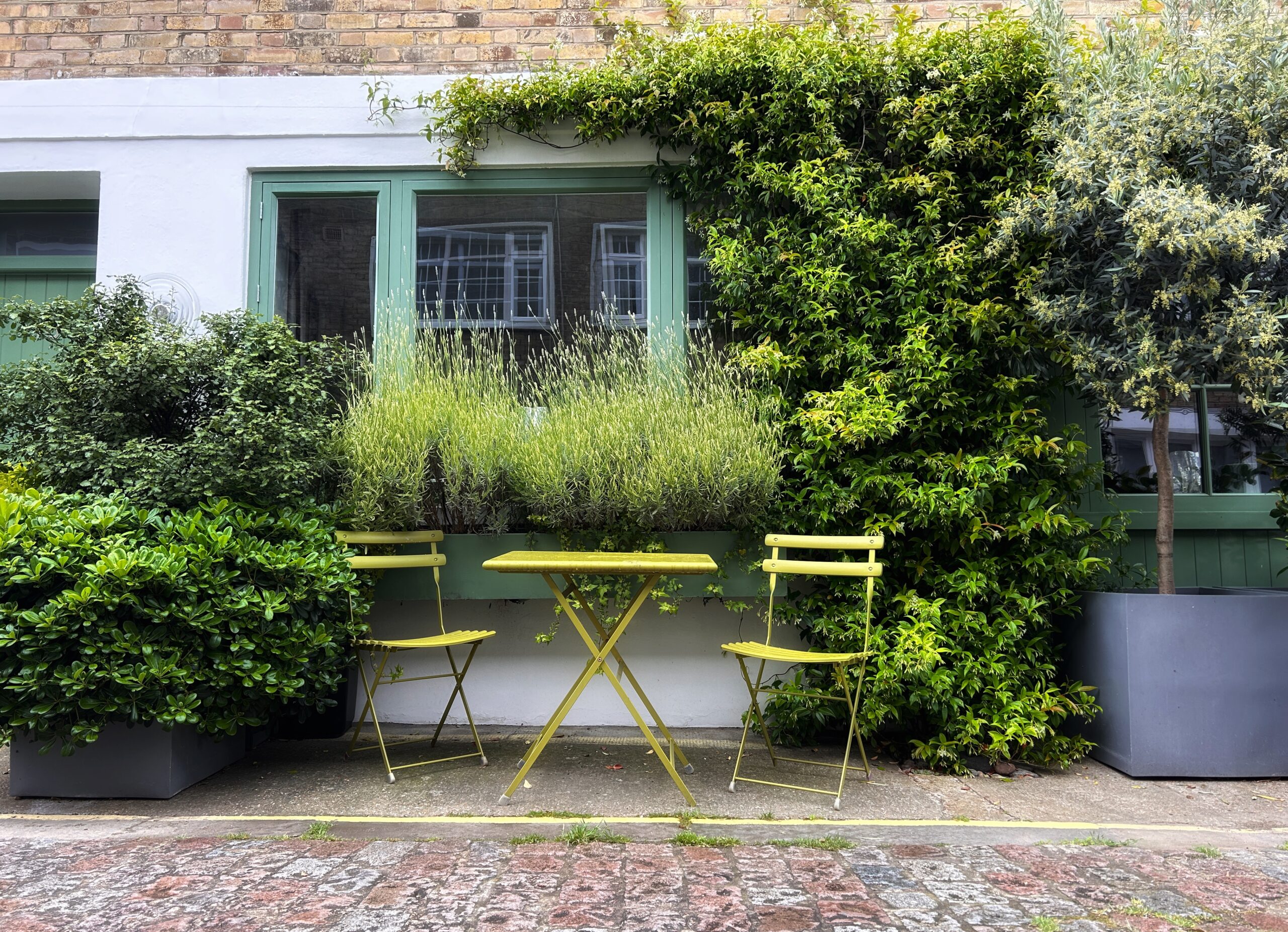
For a front garden, this translates into simple design choices: a small tree or large shrub to shade a south- or west-facing façade, climbers on sunny walls, a hedge instead of a brick wall, and planted ground rather than paving beneath windows. Together they keep the front rooms of the house noticeably more comfortable when the next heatwave arrives.
5. Good for you: the health benefits of a front garden
Perhaps the most surprising evidence concerns our own wellbeing. In a study led by the RHS with the Universities of Sheffield, Westminster and Virginia (Chalmin-Pui et al., Landscape and Urban Planning, 2021), researchers planted up 38 previously bare front gardens — each only around 10 square metres — in an economically deprived area of northern England. They then measured residents’ levels of cortisol, the body’s main stress hormone, through saliva samples.
The results were striking:
- Before planting, only 24% of residents had a healthy daily cortisol pattern. In the year after, this rose to 53%.
- Residents’ self-reported stress fell significantly.
- More than half said their front garden helped them feel happier, and 40% said it helped them feel more relaxed.
The RHS compared the stress-reducing effect to that of attending eight mindfulness sessions — achieved with just a handful of plants. To be fair to the data, overall life-satisfaction scores did not rise significantly; the clearest gains were in stress regulation.
These findings fit a wider body of research. A study of nearly 20,000 people in England led by Dr Mathew White at the University of Exeter (Scientific Reports, 2019) found that people who spent at least two hours a week in nature were significantly more likely to report good health and high wellbeing than those who spent none — and it did not matter whether those two hours came in one visit or several short ones. That study looked at visits to parks, woodland and coast rather than gardens specifically, but it reinforces the idea that regular, everyday contact with nature adds up. A front garden is the one piece of nature you pass through every single day.
6. Designing a front garden that works on every level
A front garden does not have to choose between practicality and planting. The best designs combine both:
- Permeable surfaces for paths and parking — gravel, permeable block paving, or reinforced grass — so rain soaks away.
- Layered planting: a small tree or multi-stem shrub for height and shade, shrubs and perennials for structure and colour, and ground cover to protect the soil.
- Hedges instead of walls or fences, to soften the boundary, cool the air and offer shelter for birds and insects.
- Climbers on sunny walls to shade and cool the façade.
- A rain garden or planted dip to capture run-off from the roof or driveway.
- Climate-resilient plant choices that cope with both drier summers and wetter winters.
7. Parking or planting? You can have both
For many households the real reason for paving is simple: they need somewhere to park. The good news is that this is not an either/or choice. With careful design, a front garden can hold one or two cars and still be green, permeable and welcoming.
- Plant the edges and the gaps. Cars only need hard standing under their wheels. Borders along the boundary, beds between parking bays and planting beside the front door can bring back a surprising amount of green without losing a single space.
- Use permeable, planted surfaces. Reinforced grass or gravel grids, permeable block paving and wheel tracks with low planting between them all carry a car’s weight while letting rain soak into the ground.
- Choose tough, low-growing plants for the margins. Creeping thyme, chamomile, sedums and other ground-hugging plants tolerate the occasional tyre and soften hard edges.
- Add height where the car isn’t. A small tree, a hedge on the boundary or climbers on the façade give shade, privacy and cooling without taking parking space.
- Plan the whole space, not just the driveway. Bins, bikes, paths and parking all fit more easily when they are designed together, leaving more room for plants.
The RHS’s own guidance on front gardens makes the same point: balancing parking with planting is achievable in most plots. A well-designed front garden lets you park your car and still enjoy every benefit described above.
The small square of ground in front of your home is a gift to the house, the street and the people who live there. Planted thoughtfully, it makes your home more beautiful, more resilient and more pleasant to live in — and the science shows the benefits are real.
Thinking about transforming your front garden? Get in touch to discuss a design that balances beauty, practicality and sustainability.
Sources and further reading
- Royal Horticultural Society (2015). Greening Grey Britain report. rhs.org.uk
- Environment Agency (2024). National assessment of flood and coastal erosion risk in England 2024. gov.uk
- British Geological Survey. Groundwater resources in the UK. bgs.ac.uk
- Chilterns Conservation Board (2020). Chiltern chalk streams re-bourne after drought. chilterns.org.uk
- Met Office (2025). Met Office report details rising likelihood of UK hot days. metoffice.gov.uk
- Bowler, D.E. et al. (2010). Urban greening to cool towns and cities: a systematic review of the empirical evidence. Landscape and Urban Planning, 97(3), 147–155.
- RHS & University of Reading (2020). Ivy is the most effective plant cover for cooling buildings. Building and Environment. rhs.org.uk
- Chalmin-Pui, L.S. et al. (2021). “It made me feel brighter in myself” — The health and well-being impacts of a residential front garden horticultural intervention. Landscape and Urban Planning, 205, 103958.
- White, M.P. et al. (2019). Spending at least 120 minutes a week in nature is associated with good health and wellbeing. Scientific Reports, 9, 7730.